



It's that time of the year again when individual taxpayers have to buckle down to file their tax returns with that April deadline looming ever larger - April 15 for paper filing and April 18 for electronic forms.
The process is quite simple on the surface - just declare your taxable income for Year of Assessment 2019 based on what you earned between Jan 1 and Dec 31 last year.
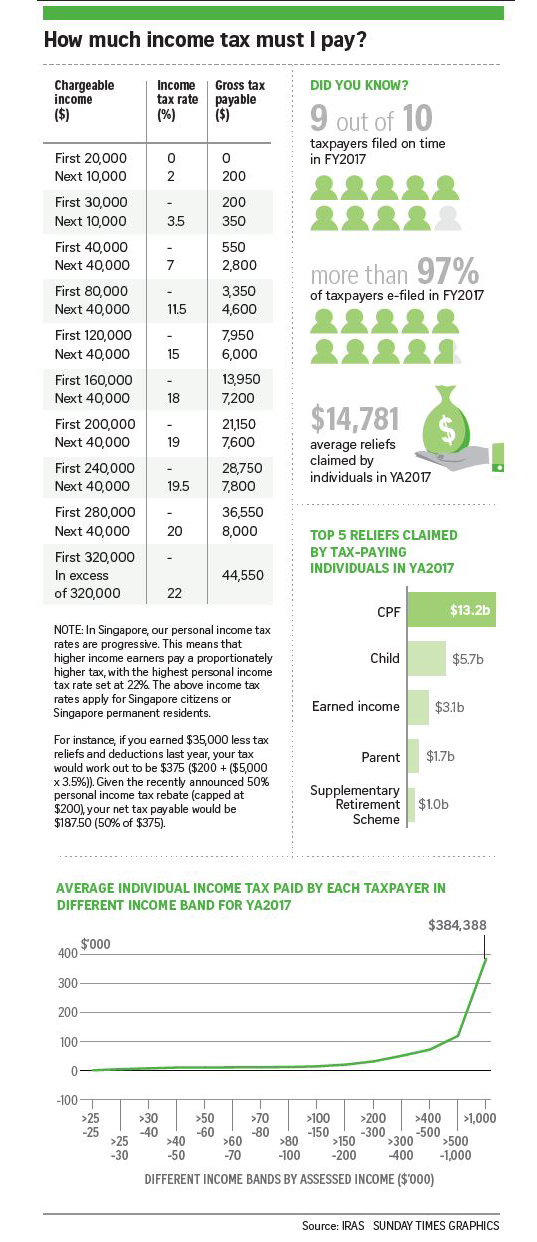
The Inland Revenue Authority of Singapore (Iras) is continuously trying to make the experience more user-friendly by simplifying tax rules and the processes for filing and payment. It is no wonder that 97 per cent of taxpayers e-file their tax returns because it is easy and convenient.
Still, filing might be an arduous task, particularly if you are doing it for the first time. The Sunday Times highlights how a new taxpayer can file and reduce his tax returns.
But before you even start, there is some good news: As part of the Bicentennial Bonus, a personal income tax rebate of 50 per cent of tax payable (capped at $200) will be granted to all tax resident individuals for income earned last year.
Steps to tax filing
STEP 1: HAVE THESE DOCUMENTS READY
• Form IR8A (if your employer is not participating in the Auto-Inclusion Scheme);
• Particulars of your dependants (for example, child, parent) for new relief claims;
• Details of rental income from your property and other income, if any; and
• Business registration number of sole proprietorship/partnership (for self-employed and partners only).
STEP 2: LOG IN TO MYTAX PORTAL
Use your SingPass to log in and click on "Individuals"/"File Form B/B1". This electronic tax form will take just five to 10 minutes to complete.
STEP 3: VERIFY YOUR DETAILS
Ensure that the pre-filled information on your tax form such as income, deductions and reliefs are accurate and complete.
Tip: If there are discrepancies, check with the relevant organisation directly. They will resubmit the information to Iras if there are errors.
STEP 4: UPDATE EXISTING TAX RELIEFS
If you have previously claimed reliefs but no longer qualify for them, remove the pre-filled sections before submitting the form.
If you qualify for additional or new reliefs (for example, claim relief for a newborn child), include the claims when you e-file.
STEP 5: DECLARE OTHER SOURCES OF INCOME
If you have received any other income that is not pre-filled, declare it in the appropriate sections on your tax form. This could be "Rent from Property" or "Trade, Business, Profession or Vocation". An acknowledgement page will be displayed after you have successfully e-filed.
What if I hold two jobs?
The gig economy is a growing sector in Singapore. You are considered a self-employed person with the additional income you earned last year from your part-time job or a side gig on top of your day job. Here is a snapshot of additional tax-filing tips relating to step 5 above.
SOCIAL MEDIA INFLUENCER
All income and benefits received must be reported unless the benefit received is given on an ad hoc basis or for a one-off consumption, and the value of the benefit does not exceed $100.
PART-TIME PRIVATE HIRE CAR DRIVER
All income received must be reported. As 60 per cent of your driving income can be deducted as expenses, be sure to indicate the right "nature of business " (that is, private hire car/taxi driver) in your tax form.
PART-TIME INSURANCE AGENT
All commission received must be reported. Report your gross commission as revenue. Business-related expenses should be reported separately.
TAX RELIEFS
While some tax reliefs such as Central Provident Fund (CPF) cash top-ups are automatically granted, some will require your action. Here is a snapshot of some of the reliefs and rebates you may be eligible for.
Why must I pay tax?
Taxpayers support nation-building when they file and pay their tax on time. The income taxes collected form part of government revenue that goes to fund expenditure for Singapore.
This includes the building of infrastructure like schools, roads, hospitals, MRT lines and other public facilities, as well as providing subsidies for health, housing and education.
The money collected also enables the Government to use a significant amount to help lower-income Singaporeans by funding social assistance schemes.
| TAX RELIEFS AUTOMATICALLY GRANTED TO YOU |
| Earned Income Relief: The objective is to recognise the employed and those carrying on a trade, business, profession or vocation. The amount is $1,000 for employed individuals below age 55 as of Dec 31 last year. For those aged 55 to 59, the relief amount is $6,000 while it is $8,000 for those aged 60 and above. |
| NSman Relief: This relief recognises contributions of eligible operationally ready national servicemen (NSmen) in the previous work year. The amount of relief is dependent on whether you are a key or non-key appointment holder and an active or inactive NSman. The amount ranges between $1,500 and $5,000. |
CPF Relief: This encourages individuals to save up for their retirement. The amount of relief is capped at the maximum amount of compulsory CPF contributions at $20,400 (based on both Ordinary and Additional Wage Ceilings). Relief for a self-employed person is capped at the lower of (i) 37 per cent of your net trade income (ii) CPF cap of $37,740 or (iii) the actual amount contributed by you. If your employer is not registered under the Auto-Inclusion Scheme for Employment Income, this relief will not be automatically granted. For self-employed persons, this relief will be automatically allowed based on Medisave and voluntary CPF contributions paid to the CPF Board in the previous calendar year. |
| Voluntary Contributions to CPF Medisave Account: This aims to encourage individuals to save up for their medical needs. The amount of relief is the actual amount of voluntary contributions you made to your Medisave account in the previous calendar year, subject to the CPF annual limit of $37,740. If the CPF annual limit is reached, no further voluntary contributions to your Medisave account can be made. You must have earned income when you made voluntary contributions to your Medisave accounts in the previous calendar year. |
| CPF Cash Top-Up Relief: This encourages individuals to save up for their retirement and that of their dependants. The amount of relief is up to $7,000 for topping up your own CPF Special or Retirement Account in cash. There is an additional relief amount of up to $7,000 for topping up the CPF Special or Retirement Account of your family members in cash. If it is for your spouse or siblings, their annual income must not exceed $4,000 in the previous calendar year. And you must hold a Singapore NRIC. |
| Relief for Contributions under the Supplementary Retirement Scheme (SRS): This relief aims to encourage individuals to save up for retirement in addition to their CPF contributions. The amount of relief will be capped at the maximum amount of SRS contributions for each calendar year. For Singapore citizens and permanent residents, the amount is $15,300 and $35,700 for foreigners. |
| TAX RELIEFS YOU HAVE TO CLAIM |
Parent Relief: This serves to promote filial piety and it provides recognition to individuals supporting their parents, grandparents, parents-in-law or grandparents-in-law in Singapore. If they are living with you, the amount of relief is $9,000. It will be $14,000 if the dependant is a handicapped parent living with you. If the dependants are not living with you, the amount of relief is $5,500. The amount is $10,000 if the dependant is a handicapped parent who is not living with you. Note that your parents/grandparents should be living in Singapore last year. They should be aged 55 years and above in 2018 (unless they are handicapped). In addition, their annual income should not exceed $4,000 in 2018 (does not apply if they are handicapped). You may claim for up to a maximum of two dependants. If the dependant is not living with you, you should have incurred at least $2,000 in costs in maintaining him or her. If more than one individual is supporting the same dependant, the relief can be shared between claimants based on an agreed apportionment. |
| Handicapped Sibling Relief: This relief recognises individuals supporting their handicapped siblings or siblings-in-law. The amount of the relief is $5,500. Your sibling must be living with you. If he is not, you must have incurred at least $2,000 in maintaining him or her. When you claim handicapped sibling relief, no one else is allowed to claim Spouse or Child relief on the dependant. |
Life Insurance Relief: This applies to individuals who did not contribute, or contributed less than $5,000, to their CPF or Medisave in the previous calendar year. The amount of relief, capped at $5,000, is the lower of (a) the difference between $5,000 and your total contribution to CPF or Medisave, or (b) the amount of insurance premiums paid on your own or your spouse’s life insurance policy or (c) 7 per cent of the insured value. |
| Course Fees Relief: The aim is to encourage individuals to continuously upgrade themselves so as to enhance their lifelong employability. The amount of relief is up to $5,500. You must have attended a course, seminar or conference that relates to your business or profession, or for the purpose of gaining an approved academic, professional or vocational qualification. In addition, the course fees should not have been paid or reimbursed by your employer or any other organisations. |
Source: This article first appeared in The Sunday Times © Singapore Press Holdings Limited. Permission required for reproduction.